Traveling light (pt. 2)
Fujisan and Yamanaka

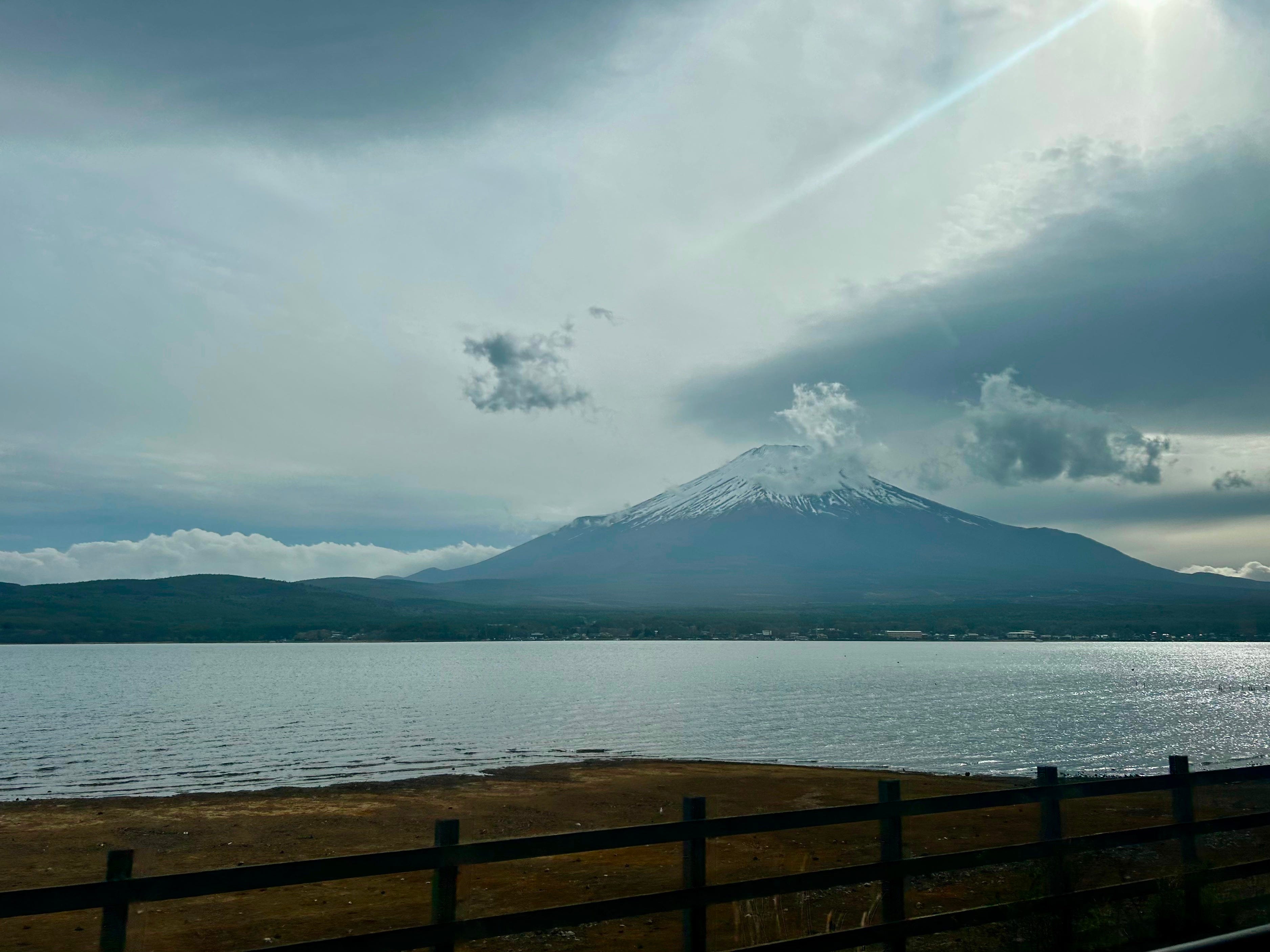
A couple of years ago, one of Kwame’s former colleagues moved with his family to his wife’s hometown, Fujiyoshida, at the base of Mt. Fuji in Japan’s Five Lakes Area. When we told him we were heading to the area, Matt offered to show us around. On the third day of our trip, we left Tokyo on a local train and within an hour felt we were in yet another country, the urban sprawl outside the window changing to scenes of smaller villages, farmland and green, tree-covered hills.
Matt met us at the small open air Shimoyoshida station beyond which the snow-capped Mt. Fuji, loomed. We were lucky to see Mt. Fuji’s profile and its shrine when we did. Clouds descended shortly after our arrival and it would rain for most of our visit. Lucky for us we were in such excellent company. It’s a treat to visit any new place, but it’s that much better when friends live there. Matt, Keiko, their young son and their extended family were exceedingly gracious and gave us an idea of what life was actually like for residents. We had an excellent time exploring their mountain town, visiting its horse and mountain shrines and pagodas, and eating at local izakaya and udon places we wouldn’t otherwise have known existed.
Mount Fuji is one of Japan's "Three Holy Mountains" and it was easy to see why: at more than 11,000 feet, it’s the tallest peak in Japan, a longtime muse of artists and writers, and a World Cultural Heritage Site. It’s also an active volcano (it last erupted in 1707)! The ancient, expansive, Shinto Kitaguchi Hongu Fuji Sengen-jinja Shrine, including several 1000-year old cedar trees, served as the opening to the mountain’s tree-lined trailhead. We spent some time wandering around the shrine, the old growth forest and the very beginning of the path up the mountain. Deep bows were in order.


Wear your rain jacket
En route to the pagoda
Mountain is hiding
When we took shelter from the rain, we had a sweet (and kind of hilarious) time attempting to converse with Keiko’s parents (again with the help of Google Translate) over tea and greens from their garden. The other bonus of the soggy weather was that it kept the usual crowds away. Keiko said her small town had changed greatly in recent years, and a New York Times article1, published a few days after we were there, spelled out exactly why. I had been oblivious to the fact that many people visited Fujiyoshida specifically to take a picture for Instagram.
Children wear bear bells
Hibernation is over
School lets out at three
We had lodging about a half hour away, near one of the Five Lakes, Lake Yamanaka, formed by lava flows from one of Mount Fuji’s ancient eruptions. With all its geothermal activity, Japan is full of natural hot springs with a whole bathhouse tradition around them which we enthusiastically embraced. Our rooms came with cotton robes, slippers, special towels and a note about onsen etiquette in their respective men’s and women’s tubs.
I was also excited because we were above the lake, on a wooded hillside, ripe territory for more new-to-me birds. Our first morning there, I got up early before the rain started and headed outside, the sound of birdsong filling the air. Upon opening up the Merlin Bird Sound ID app, it immediately let me know it recognized less than 50 percent of the birds singing around me. Given I was hearing far more than 50 percent of the birds I was actually seeing, this was maddening. Merlin’s sound ID feature has been a boon to North American birders since it was released in 2021 and I’ve been leaning on it hard ever since I found out about it. Attempting to bird in a foreign land without it was a great lesson in being a complete beginner again.
While it wasn’t of immediate use to me in Yamanaka, I did use it, minimally, as a recording device, and maximally as a direction, by listening to its audio samples and comparing and contrasting those with what I was hearing.
What was most useful, was going back to basics, using my senses and paying that much more attention. I stood at the edge of the parking lot, peering into the woods beyond the pavement and the hotel grounds, craning my ears as much as my eyes, hoping no one was going to grab me by the arm and ask what the heck I was doing.


Unlike Tokyo, this part of Japan was light on English speakers. I was one of the few people up and about, but I still cued up a phrase in Japanese just in case I had to explain myself:
“tori o mite imasu” aka “I am watching birds.”
Or trying to.
What were the qualities of what I was hearing?
Jays and crows and a woodpecker drumming, something Robin-like, something warbler-like, something kind of like a house-finch.
Who might I actually see in this location at this time of year?
I scrolled through Merlin’s ‘likely birds’ feature, clicking on audio clips for the birds I thought something could be. Occasionally, a bird gave me an actual view of itself (thank you, proud Oriental Greenfinch singing from a tree top; thank you Hawfinch flying near the parking lot!), but there were far more birds in that forest than I could identify. Eventually, I did as most of the other humans were doing at the hotel and headed for the onsen. To my delight, a couple of birds showed themselves while I was in the outdoor tub.
We could easily have stayed a few more days in this area, and we were so grateful for the hospitality and experiences we enjoyed in the time we had.
Yukata and towel
Sauna room, tub, seated bath
Pygmy woodpecker
In the Foothills of Mount Fuji, the Fight Is On Against Unruly Tourists https://www.nytimes.com/2026/04/26/world/asia/japan-fuji-tourism-cherry-blossoms-overtourism.html