Keeping it real
hearts and bones, feathers and fur amid AI

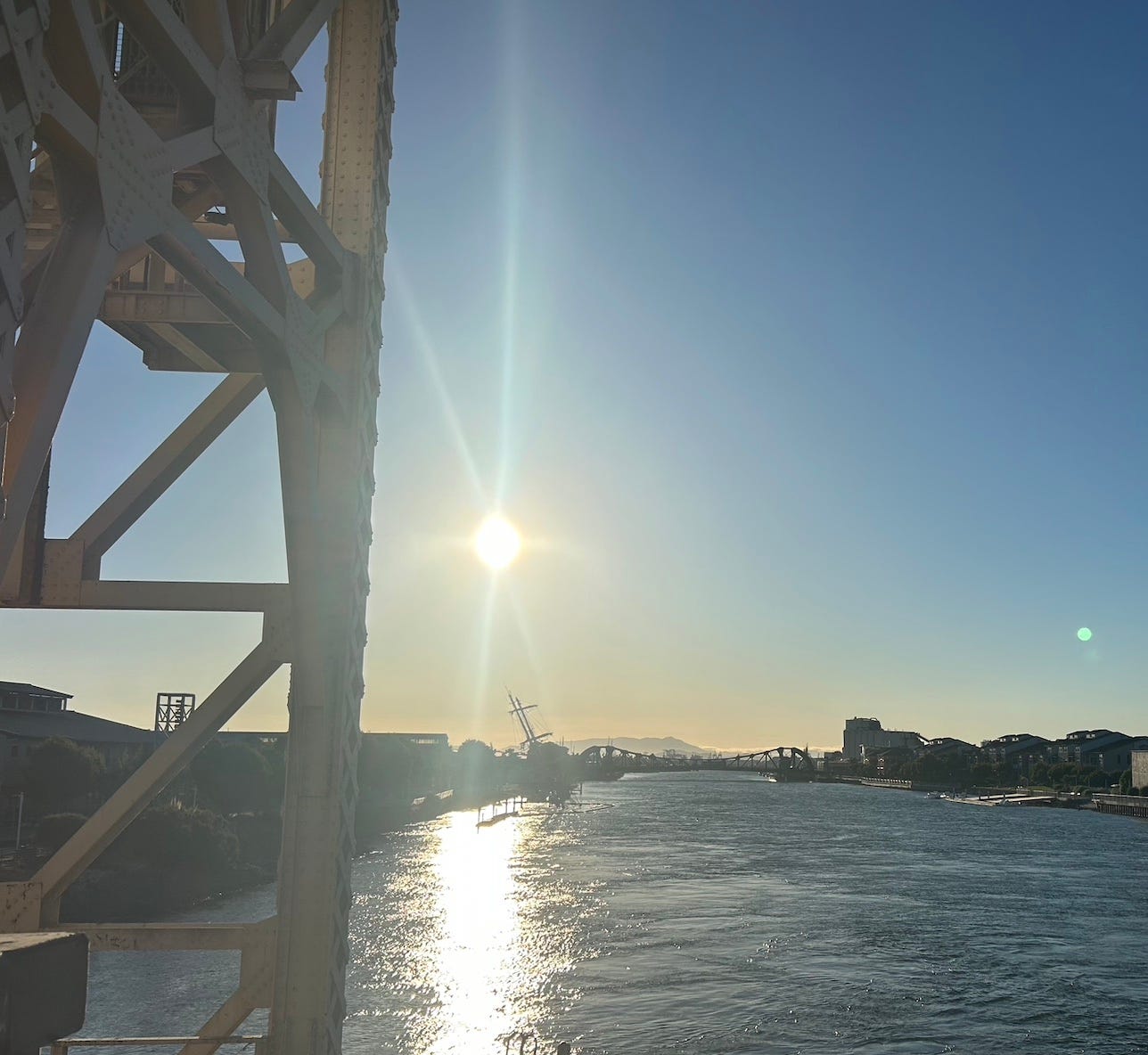
We don’t really need an alarm in the summer. If we’re not awake by the time the sun rises, especially on days when the fog has stayed offshore, our 13-year-old feline, Sammie, is walking across us, asking for food or to be pet or simply checking that we’re alive, I’m not certain. I can’t begrudge her. Little cat paws, like the summer light, feel like a gift. Every year when the days start to lengthen, I feel a slight astonishment at how the bright light brightens my mood. Everything feels more possible. What might the day bring? What might I do with it?
These past weeks, that’s meant getting on my bike more again, veering toward the water when I can, and spending that much more time watching the new generation of birds find their way to the air.
In June, that took the form of participating in two bird watch projects, Fledgewatch and Tern Watch. Fledgewatch is about watching urban falcons closely to see that they’re navigating the airways safely and be there in the event they run into buildings or cars when they’re learning to fly. Tern watch is more about watching out for potential predators who might prey upon the new hatch chicks. But keeping an eye out for reason doesn’t mean you won’t see a lot of other things.
The local Peregrine Falcon pair, one of the few who nested in the Bay Area this year, reared three young, with two of the three maturing into strong flyers on schedule. The lone male of the bunch was slower from the start, his flights lower and less sure. After a grounding, a rescue, a re-release, he slipped from the view of we fledgewatchers. He may be out there still, doing just fine, but we might never know. As I’ve written before, it’s astonishing how quickly these birds go from egg, to hatchling, to fledge to competent flyer. Down starts turning to feathers after 21 days and they start to take their first flights after 40 days. Within two months they’re starting to hunt on their own. Amid it all the parents are coming and going and chasing off potential or perceived trouble in the form of an Eagle or Pelican or human. And life, human and otherwise, is going on all around. Invariably, someone stops by to ask what you’re watching; at least two people had the local squirrels on a regular feeding schedule of their own design. One evening, a man ran their small boat ashore and the nearby parking lot filled up with fire engines.
Last week we were watching the young female birds chasing insects and gulls over the water. This week, I rode my bike down to the nest sight to see how they were doing but all was quiet. A couple of Snowy Egrets flew low over the water while a man swept the sidewalk. A flock of pigeons milled about on the grass. If I hadn’t been there when the falcons were active, I wouldn’t have known they nested so close.
Across the island, the Least Tern colony was bustling with a record number of nests. Unlike the falcons, the small seabirds nest en masse and find their strength in numbers. If a potential predator flies over the colony or enters it on food, hundreds of birds fly up in a dense ball, in hopes of distracting and confusing the threat. The falcons on the other hand, go directly after their threats, diving on them, screaming at them and chasing them in high-speed pursuits. Still, the birds are as similar as they are different: fast, pointy winged flyers who hunt — fish in the case of terns; other birds in the case of falcons — rather than glean their food. Both species are either threatened or endangered. Both species tend to be monogamous and stay together over multiple nesting seasons. Neither build nests rather than make scrapes, one in sand, the other on cliffs or cliff-like structures like bridges and skyscrapers. The smaller and lighter terns move through their reproductive cycle even faster: incubation lasts only 20-25 days, and they’re taking flight three weeks after hatching.
I was out at the colony for my last Tern Watch shift last week and the terns in every part of their life cycle were seemingly everywhere, incubating, courting, defending territory, carrying fish, feeding the tiniest chicks, winging over and running around the tarmac outside the fenced off nest site (one of the cardinal rules of Tern Watch is to never back up!). In another month, they’ll all be gone, off to Mexico and Central America to spend their nonbreeding season where it’s warmer. The tarmac will go back to looking deserted. If you missed the Tern Watch you would question, as a trespassing local did last winter, why the area was a designated Wildlife Refuge. If no one was paying attention, like the bird-watching wife of a Navy Air Station commander, who first identified the endangered Terns nesting on the base in the 1970s — the birds would likely not have a breeding site to return to.
Just like if I didn’t look at a weather map or social media, I could forget how inflamed the country and the world is right now. The heat domes over the eastern part of the US and Europe, the tragic doublet earthquake in Venezuela, and fires in Utah and Colorado echoing our angry discordant government and AI-obsessed Big Tech. Hot, overblown, overheated, inflamed. I thought this morning, in my half awake state, the cat’s paws moving across me, the hopeful summer sun coming through the window, how so many people who are pecking queries into phones and computers to find answers or create images using AI have no idea how much energy it is burning, how many species its data centers are displacing, how much its contributing to climate change, because they can’t see it. How we can watch all these disasters unfold on screens and fool ourselves into thinking its not our problem. I thought of a chilling story I read about how another Big Tech player and AI proponent (who I’m loath to name) reportedly hesitated when asked about the value of humans continuing. Implied of course was that some humans were superior, or superior to the point of being beyond human? Humans can definitely be problematic, especially, I think, when we assign hierarchies, so how can something based on humans be better? AI doesn’t need faith or food or sweat or tears or relationship to come up with answers. Not in real time. But everything AI “knows” came from human blood, sweat and tears. Every data center site was once a unique ecosystem that took millennia to evolve. And I kind of doubt any of the billionaires batting around ideas of “transhumanism” with AI has considered the intelligence of other animal and plant species and the roles they play on the planet. Hubris. Ugh.
Video: neither tern nor falcon, but new Cooper’s Hawks who just fledged even closer to home.
Late in the week, we were walking in our neighborhood, and over the sound of traffic I heard a familiar sound. I stopped in my tracks and looked up and around: two young Cooper’s Hawks were atop the telephone pole plaintively crying and flapping their wings. Months ago I saw the adult flying low over the treetops but things had gone quite for a while and I wasn’t sure if they were even around anymore. There is always more going on around us, there to discover (or not), which I love.
Observing the rhythms of the birds who also call my town home, attempting to make something based on my own experience, spending time with other humans in real time, always nourishes me more than scrolling through social media. I don’t want to take direction from a machine. Nor do I want to be immortal. Heart and bones and feathers and fur. None of it, lives and the stuff of life, lasts forever. Life in all its forms is often messy, inherently impermanent but that’s no cause for its erasure.
Golden Gate Bird Alliance recently launched BirdPulse, their new tool that utilizes data from Christmas Bird Counts and eBird to give folks a snapshot on how individual bird species are doing in the Bay and the opportunity to be more responsive regarding conservation opportunities. Check it out HERE.
“If the billionaires are so determined on quitting humanity, perhaps it would be best to give them what they want and sponsor a mission to Mars so humanity can rid itself of them”1
‘The Billionaires are Abandoning Humanity https://www.thenation.com/article/society/peter-thiel-billionaires-abandoning-humanity/
Hear hear!