Easter eggs

Easter Sunday was a thing in my childhood. My mom was a practicing Catholic so there would be a late-morning church outing to prepare for before heading to grandma’s house for a holiday meal. Getting ready meant figuring out an Easter dress, bought new or newly-handed down. For us kids, though, Easter was all about the Easter egg hunt that kicked off the day. Dad, a long-lapsed Catholic, opted out of church but could get behind playing the Easter Bunny, a stealth role that involved his hiding eggs all over the yard after we went to bed.
As we got older, eggs were assigned dollar values between $1 and $5 with the hardest-to-find eggs worth the most. There were a lot of potential hiding places: in the planter boxes, under the eaves, on the gopher-hold-pocked lawn, in the branches of the apricot tree or in the duff under the bottle-brush that lined the driveway. On more than one occasion, an egg might remain hidden long past Easter to resurface at some random moment later in the year (I recall an argument over whether an egg found in July would merit the reward).
While we were running around outside, competing for the most eggs, Mom would fill our individual Easter baskets with the requisite PEEPS®, Reese’s peanut butter eggs, jelly beans and chocolate bunnies. One Easter we woke up and the driveway was scattered with individually-wrapped, chocolate-shelled malted eggs which thrilled us no end. It wasn’t hard to sit through Mass after all that.

My surviving elder, my aunt, still observes the Easter traditions to some extent (sans egg hunt), so she was disappointed to hear I’d booked up my Easter with alternative, if egg-adjacent activities including a rehearsal and a trip to a bird-banding station.
Spring bird migration is approaching peak, so when an opportunity came to visit a bird banding site in Concord, I took it. That meant getting up at 5:30am on Sunday morning and driving to the Galindo Creek Songbird Banding Station.
Bird banding has been used by scientists for more than 100 year to identify and track individual birds. Scientists put aluminum or colored bands, each band engraved with a unique set of number, on birds. Banders must have a permit from the United States Geological Survey, which runs the Bird Banding Laboratory (BBL), to run a banding station. For good reason: it takes a lot of skill. Birds are caught using mist nets, carefully extracted, then measured, weighed and aged before they get their band, then released. Every bird’s information goes into a database: if its re-caught or recovered, it’s band # can be searched and much of the story of its birds life — its age, where it migrated, how far it traveled, etc — can be revealed.
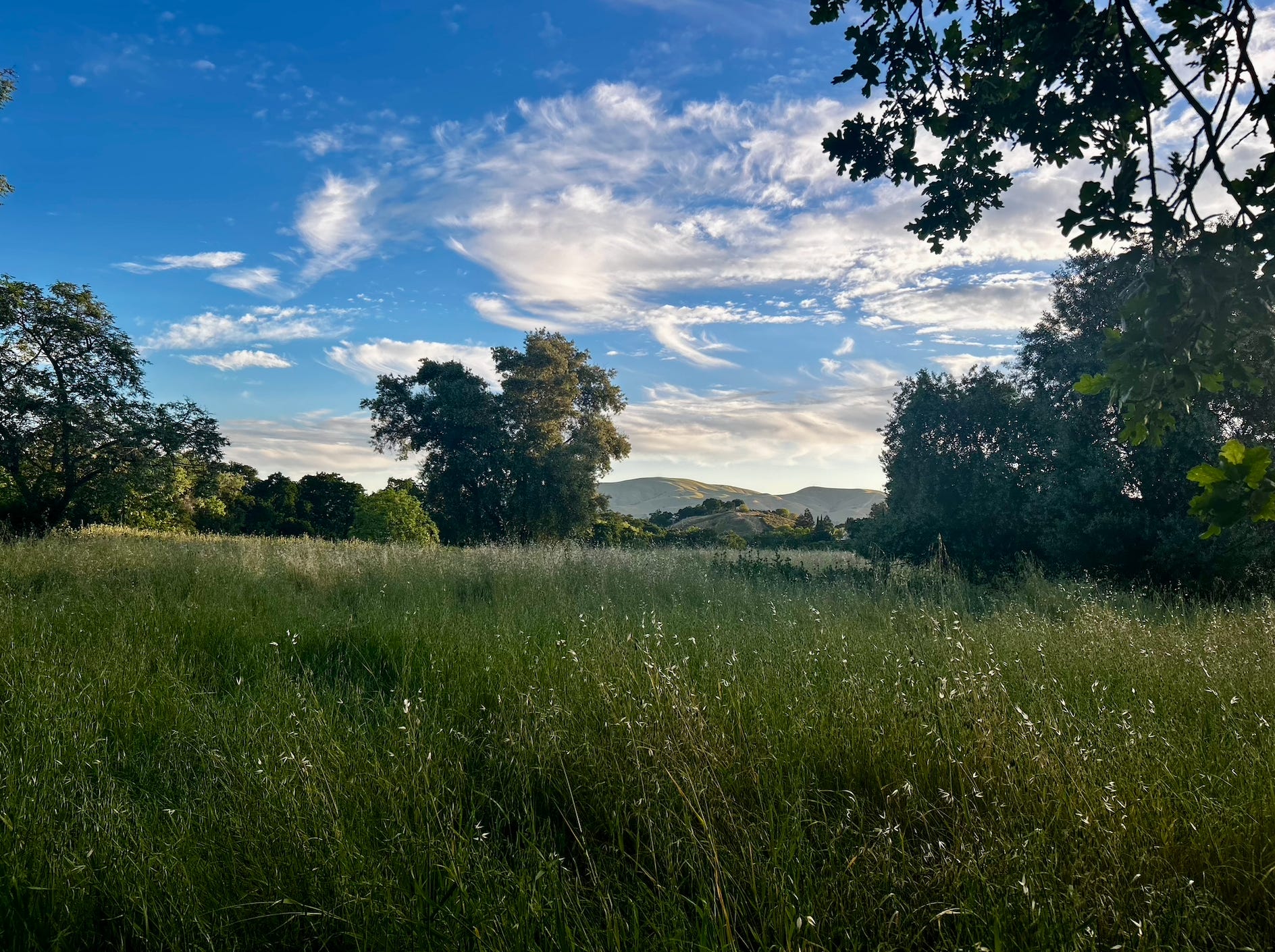
The Galindo Creek Field Station — inland, in a riparian area next to a field up the road from some sports fields on the Cal-State East Bay Concord — was lush with tall grass, creekside bushes and trees. As we volunteers arrived, the air was full of birdsong: Red-shouldered Hawks yelling; Lesser Goldfinch whistling and sighing, and a bunch Yellow-rumped Warbler chek-chek-chek-ing from the trees — the core team and were ready to start erecting nets and collecting data. Hallie, the master bander and permit-holder was the ringleader who did the bulk of the banding with two skilled volunteers.
I last visited a banding site (the still-operational Palomarin Field Station in Point Reyes) during college and the protocols haven’t changed much over the years. A series of mist nets are erected and then banders wait a prescribed number of minutes before going out to check them. Whatever flew into the nets is extracted, placed into a cloth bag with a numbered clip, and then taken to the banding hub: a small table in a clearing under a tree with a tackle box full of different-sized bands, two clipboards, a white-board, calipers, pliers, small scissors, a bespoke ruler and a scale that measures weight in grams, plus a copy of the Peter Pyle’s incredibly technical Identification Guide to North American Birds, Part 1.
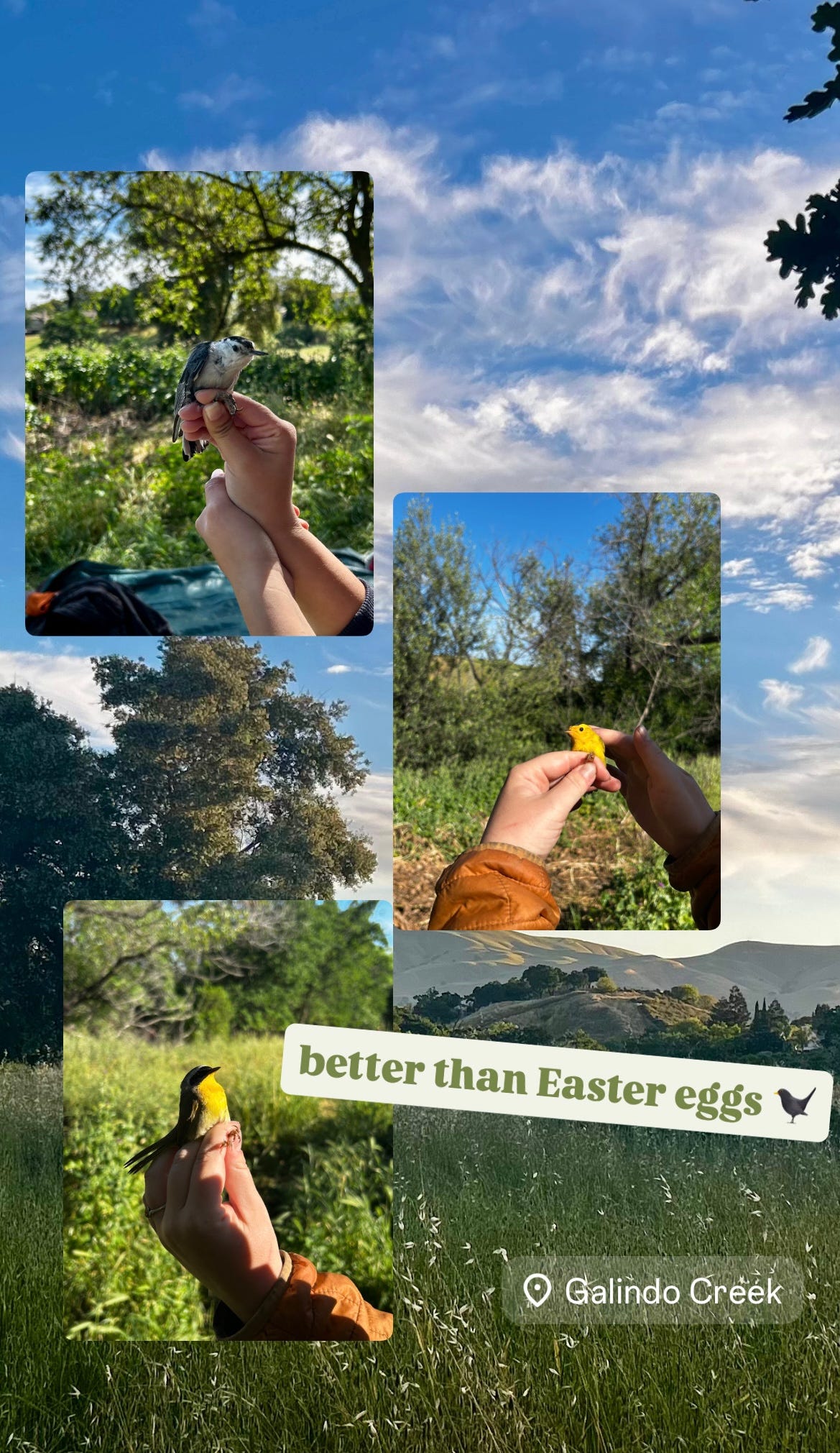
We visitors mainly tagged along to check the nets and hover while each bird was taken out of its bag and measured, weighed, aged, and checked for molt patterns. They also let us release birds, showing us how to use a “bander’s grip” to place two fingers gently around the birds shoulders so that they touch in front while the other fingers lightly encircle the body. Then we crouched low to the ground, placed the bird on our left hand and set the bird free. Some birds might rest a moment on an open hand but every bird I handled — a White-crowned Sparrow, a Yellow-rumped Warbler and a couple of Lincoln’s Sparrows — flew off from my hand immediately, some letting out a chip or two before disappearing into the bush. The birds were so light, between 15-25 grams in most cases (Kinglets weighed less than 10 grams!) and mostly what I felt was the slightest touch of their toes as they lifted off.
It was a busy day. More than 40 birds came into the nets, including a Nuttal’s Woodpecker; two Yellow-breasted Chats; a female Ruby-crowned Kinglet with a tic-tac sized egg (an Easter egg of another kind!) in her oviduct; a rightfully-combative Black Phoebe, and a Hammond’s Flycatcher which needed some botany-level checks to accurately identify, even in hand. Two male Anna’s Hummingbird mid-chase, flew into the nets as well, though they weren’t banded, hummingbirds needing a whole other level of handling care as well as hand-rolled bands.
The whole experience was exhilarating. The regular crew cautioned that it wasn’t always so busy: like most field work, some days can be slow, excruciatingly boring or rife with challenging weather. But then there’s the reward of getting close up to something wild and beautiful and picking up more clues to just how the wild and beautiful is navigating this world.
I know focusing on nature has been helping me navigate — and find some relief from — the anxiety and dread I’ve been feeling a lot these days. Getting up so early on Sunday meant I was oblivious to the latest outrage until much later in the day. I wished I had a banding site to hide at on Tuesday! Today I just feel sad and angry: I hope we Americans can successfully invoke the 25th Amendment and get to the polls, and that peace and good sense and best of humanity will prevail.
Of course hope alone isn’t going to make a difference. I just found out about the Dashboard for Climate and Dashboard for Democracy, two tools that simplifies taking daily action to try to right this ship.
Take care out there.