Birding out
without tuning out

How is it going out there? Are you, too, having a hard time relaxing knowing that the president you didn’t vote for has started a war? How does one enjoy the spring weather while blinking at the reports — real? imaginary? AI? — about possible drone attacks?
I didn’t see that news — or conjecture? — until after I drove halfway across California, returning home from a somewhat spontaneous So Cal bird adventure, my brain divided the entire time between wow, California is so big and so beautiful and how are all these other people in cars, cruising down the highway, coping? And knowing, too, my whole impulse to shoehorn a trip to Borrego Springs into the week was green-lit by the fear-rimmed thought, if not now, when?
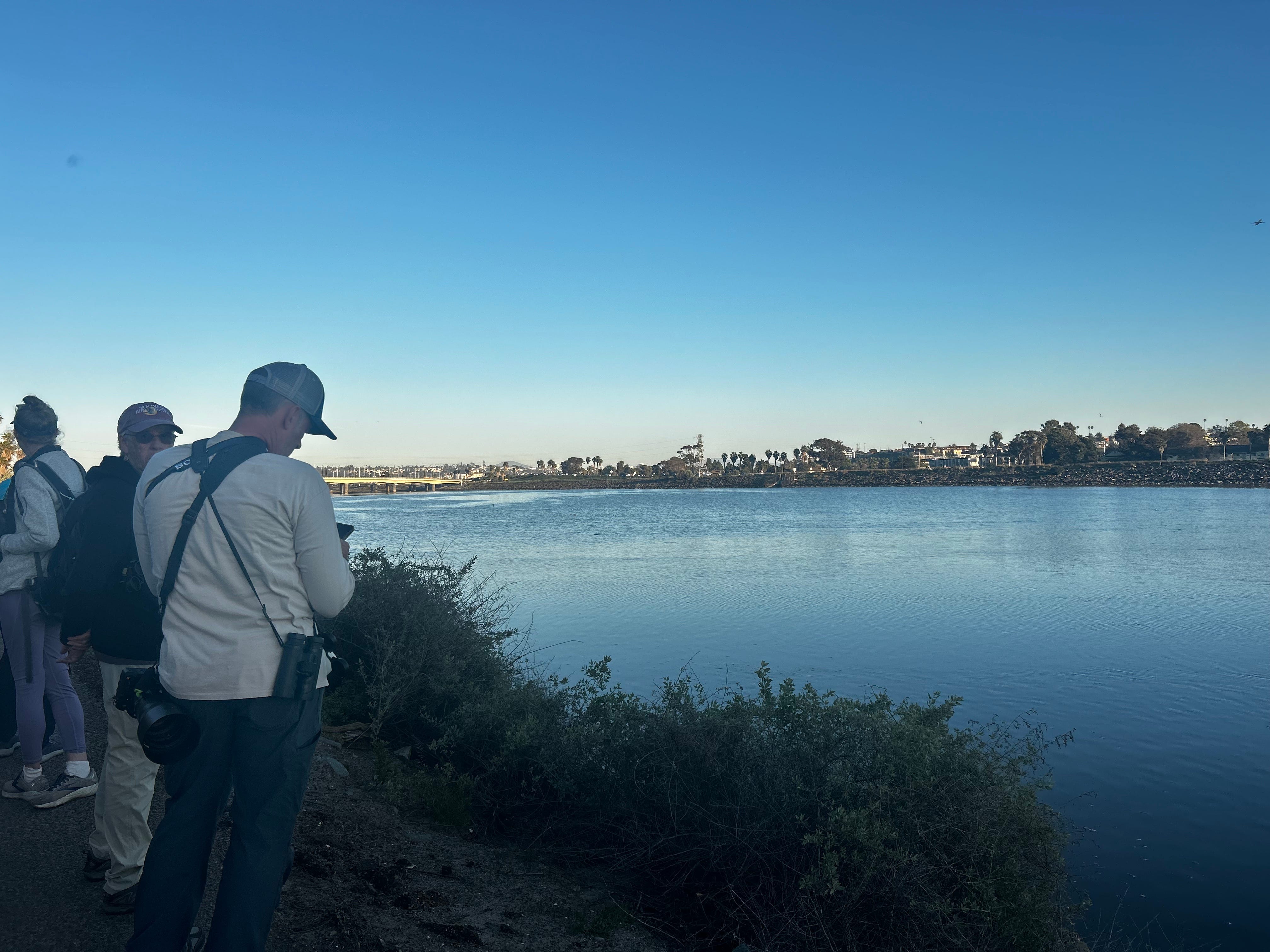
This led me, first to the San Diego Bird Festival a couple of weeks ago. I had such a great time at the Morro Bay Bird Festival. I reached out to the good people in San Diego and soon found myself signed on to lead a kayaking bird field trip as part of their extensive programming. The weather in San Diego in late Feb/early March was glorious, much to the delight of the conference goers, a great many of them who flew in from across the country. Of the 14 people on the kayak trip, I think only four of us called California home; more than one had just experienced the blizzards on the East Coast! It was a great group of people (including the kayak lead, a marine biologist and ocean educator), everyone awake and happy to be there, paddling around Mission Bay in the crisp, blue air. Some people were seeing some species for the very first time! And there were a lot of great birds: Reddish Egret and Little Blue Heron, Brant and Long-billed Curlew, Royal Tern and Brown Pelican and more.
Later in the day, I joined another 70+ people for an estuary walk around the marina near Conference Headquarters and then toward the San Diego river mouth which ended up being a lot of fun as well, people sharing bird stories and birding tips as we scanned the shoreline and mudflats which was crowded with birds. Loads of Wigeon and Cinnamon and Blue Winged Teal, and again, the suite of waders: Great, Snowy, and Reddish Egrets; Great Blue, Night and Little Blue Heron. A Belted Kingfisher hunted from the bridge.At one point someone recounted seeing something for the very first time and everyone cheered. A real spirit of learning and shared discovery permeated the whole experience. More of this please!
At dusk, I went back to the hotel and slept the hardest I have in weeks. The next day I enjoyed a documentary about the Swainson’s Hawk migration in Borrego Springs. I had a dim awareness about the hawks staging their each spring, on their way from Mexico and South America, before heading further north to their breeding grounds. After nearly 15 seasons of hawkwatching at Golden Gate Raptor Observatory, I was fascinated to hear how this group did their count, in the middle of a flat desert valley, with birds who take a very different flight pattern.


Seeing the Hawkwatch film, talking with other hawkwatchers, put a bee in my bonnet about going to Borrego Springs site as part of an already-planned trip Pasadena. Let’s see….an arty desert towns surrounded by beauty. A general sense of discovery and possibility. Raptor migration…road trip….It would (and did) entail a lot of driving but I couldn’t resist, even if I first had a couple of rehearsals, a gig, and the installation for bird-art exhibit I curated for Rhythmix in between.
If not now, when?
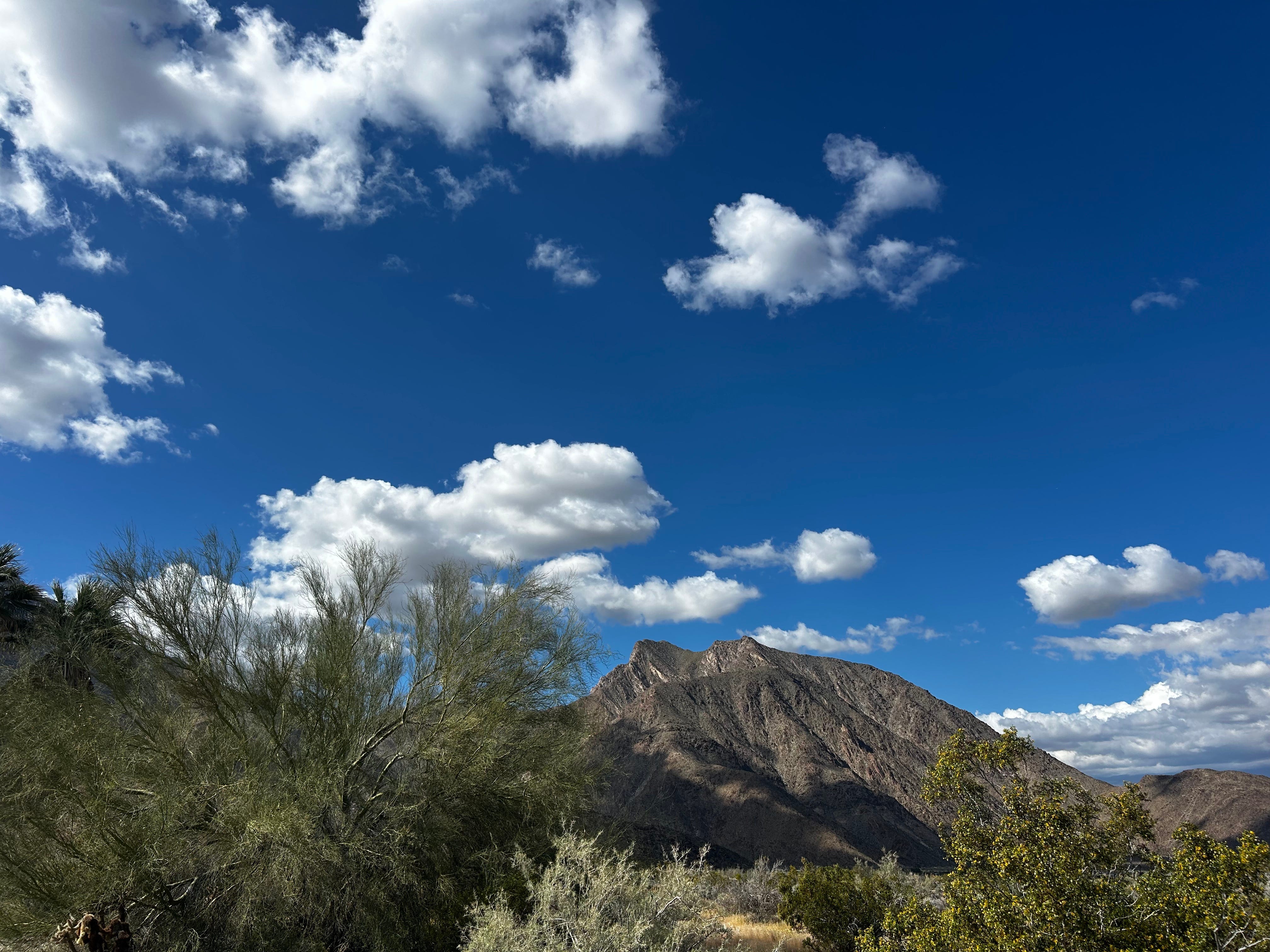
California is so big. This is not news, but driving half its length, then much of its width in a couple days, spells out its size and diversity plain. Oceans and mountains, lake shores and deserts.
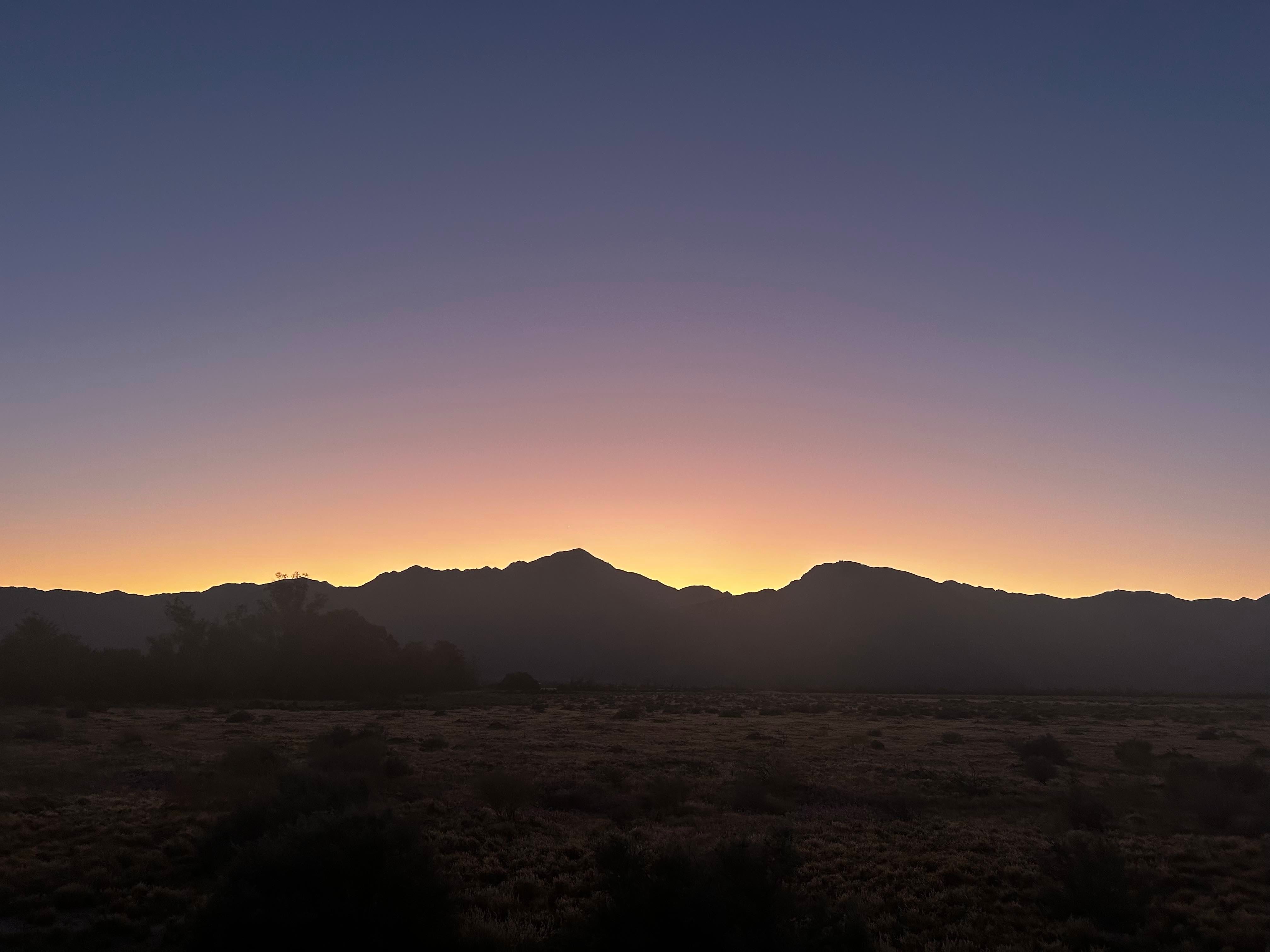
I woke up Tuesday to the sound of coyotes and chickens and barking dogs. The sounds of the desert, in this case, the Sonoran Desert. I saw a coyote as I was circling the fields north of Palm Canyon Road, which cuts across the Borrego Valley floor, looking for the evening Hawkwatch. Nearly 600 feet above sea level, the surrounding mountains— Santa Rosa, San Ysidro, and Vallecito — are all between 3000 and 8000 feet. An hour before sunset, the crew started to arrive ready to witness the incoming birds from a small dune a few feet off the side of the road. The evening watch assesses what the morning watch — who does the official count — can expect. Two days before, 100 Swainson’s Hawks had come through. On Sunday they had 15 birds.


We stood, staring across the palms and at the mountain ridge I’d driven over earlier in the day, watching the sun set behind one of the mountains. A few Ravens flew by but in general it was pretty quiet. I chatted with the site leaders — including Hal, the semi-retired Hawkwatch director whose been monitoring the site for more than 20 years, and the documentary filmmaker — as well as a couple other bird fans who had likewise seen the film at the SDBF. At one point, we got excited by a distant flock of birds over the ridge that turned out to be a bunch of Turkey Vultures.
It was getting darker and I wondered if the evening watch might be a bust. There wasn’t much wind. Nature, birds, are on their own timeline. Maybe the birds had stopped somewhere else overnight? Then someone said, “oh look,” as as if out of thin air, dozens of Swainson’s Hawks appeared in the sky above our heads, descending in slow circles over the ancient seabed, now covered in sandy fields and dotted with wildflowers, before landing on a a group of trees a little north of our viewing area.
I spent the morning at the Hawkwatch site, where another group of official watchers and visitors like me assembled to see the birds who came in Monday evening lift off and head north toward the Sacramento Valley. After lingering a bit, the group dispersed and I drove east to the Salton Sea and the Sonny Bono Salton Sea National Wildlife Refuge.


A mashup of agricultural fields, Sonoran Desert and saline lake, the are has one of the highest numbers of bird species in the country. I found the visitor center after driving through miles of agriculture, stopping occasionally to look at large, mixed groups of ibis and egrets. At the center, a ranger gave me a map of areas with good viewing sites.
“One Burrowing Owl, two Roadrunners and three bunnies,” I texted Kwame at one of my status checks as I drove slowly along the edge of the refuge. Another place where you can spend a week, my short visit was definitely a reconnaissance effort.
Later, having returned to Pasadena, Kwame and I caught up a roof-top restaurant along Colorado Ave, shaking our heads at the fact of our sitting in the California sunlight, sipping a 'beet-forward mocktail,' while noshing on pretty food surrounded by pretty people, bright green parrots squawking from the nearby palm trees, as oil rained on a city a world away. There's a hugely important migratory flyway through the Middle East as well….
All this birdy business has left me little time to keep up to the minute about the news, but it’s there, a singed edge to my days. I worry for the innocent people and birds and animals stuck in the cross-fire. I worry about inflation and have to bat away darker thoughts. A month ago it was fear that someone would break into the house. Now it’s fear about living near a former naval base. Could it be a mistaken — or not mistaken — target?
I just went to the grocery store and was reminded, as I was putting staples in the cart, of the way I felt going to the store in very early March 2020, a few days before things shut down. We still didn’t really get what Covid-19 would mean for us, and the lock-down was looming, albeit, only forecast for two weeks. And like then, now I wasn’t really sure what I needed, wasn’t exactly feeling inspired about cooking, wasn’t sure how to plan. I perused the shelves with both a low-level urgency and confusion, figuring paper towels and TP and oatmeal are always good to have around. For now the sky and air are clear …and the March 28 No Kings March is forecast to be the largest protest in US history.
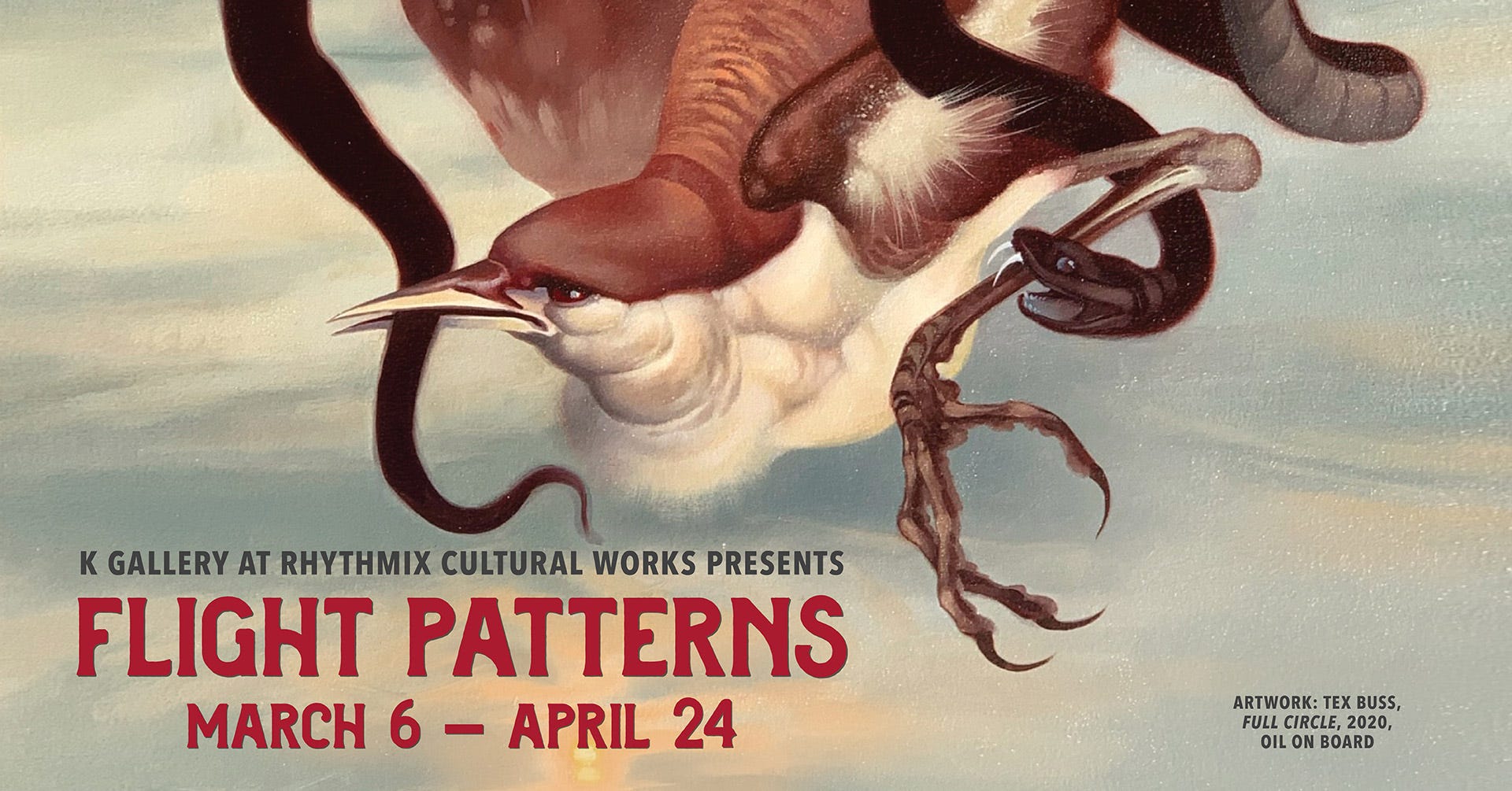
As a bird lover and Alameda resident, it was a real joy to curate Flight Patterns: A Celebration of Alameda Birdlife for Rhythmix Cultural Works’ K Gallery. Featuring painting, prints, photography and sculpture by eight amazing artists: Brice Binder, Tex Buss, Jean Chen, Flavia Krasilchik, Rick Lewis, Mary Malec, Christopher Reiger and Dana Zed. Join us for an opening reception, this Friday, March 13, from 6pm to 8pm!
The show will be up through April 24, on view by appointment and before events, including at my April 17 performance of Flight Lessons: A Folk Opera, which tells another local bird story.